
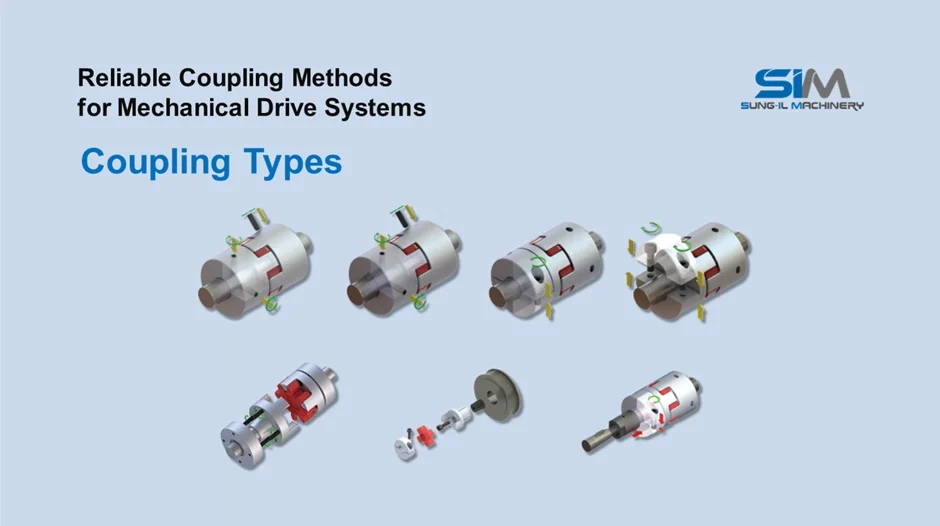
Choosing the right coupling is essential for achieving reliable power transmission, stable operation, and easy maintenance in mechanical drive systems. One of the most important factors to consider when selecting a coupling is the clamping method used to connect the coupling to the shaft.
SUNG-IL MACHINERY provides coupling solutions designed for different shaft connection and power transmission requirements. Depending on the application, different coupling types use different shaft connection methods, including set-screw, key and keyway, side-clamp, taper-ring, shaft-insertion, and tapered bushing designs.
Each method offers different advantages in terms of clamping force, installation, maintenance, shaft protection, space requirements, and cost. This coupling selection guide explains these major clamping methods to help engineers and equipment designers choose a suitable coupling for their applications.
Main Coupling Clamping Methods
- Set-Screw Type
The set-screw type coupling is one of the simplest and most economical shaft connection methods.
How It Works
The coupling is clamped onto the shaft using the thrust of screws. The screws make direct contact with the shaft surface to secure the coupling.
Advantages
- Economical design.
- Simple structure.
- Easy to install.
- Suitable for applications where a basic shaft connection is sufficient.
- Key & Keyway Type
The key and keyway coupling method uses mechanical interlocking between a key installed in the shaft and a matching keyway in the coupling hub.
How It Works
The key and keyway interlock with each other to secure the coupling to the shaft and transmit torque.
Advantages
- Provides better clamping force unless the key or coupling hub is damaged.
- Can be used as a complementary method with set-screw or side-clamp methods.
- Provides a mechanically secure shaft connection.
- Side-Clamp Type
The side-clamp coupling type secures the coupling to the shaft using fastening screws positioned vertically relative to the shaft.
How It Works
When the fastening screws are tightened, the side slits in the coupling cause the inner diameter to contract around the shaft. This creates a strong clamping connection without directly pressing a screw against the shaft surface.
Advantages
- Higher clamping force than the set-screw type.
- Easy and simple installation.
- Provides a secure shaft connection.
- Side-Clamp Hub Split Type
The side-clamp hub split type is an enhanced version of the conventional side-clamp design.
How It Works
A section of the coupling hub can be completely split apart. The coupling is installed and clamped using a process similar to the standard side-clamp type.
Advantages
- Connected equipment does not need to be shifted during maintenance.
- Provides higher clamping force than the general side-clamp type.
- Convenient for maintenance and equipment servicing.
- Taper-Ring Type
The taper-ring coupling type uses a wedge-shaped inner and outer ring structure to create a strong shaft connection.
How It Works
The coupling is clamped to the shaft by tightening screws that interlock the wedge-shaped inner and outer rings. The taper mechanism generates a strong clamping force around the shaft.
Advantages
- High clamping force.
- Self-centering function.
- Excellent self-balancing characteristics.
- Suitable for applications requiring accurate and stable shaft positioning.
- Shaft-Insertion Type
The shaft-insertion type coupling provides a compact shaft connection method designed for applications where installation space is limited.
How It Works
The bushing and insert hub are tightly connected through the thrust generated by fastening screws. Due to the taper structure, the insert section expands outward and clamps against the inner diameter on the opposite side.
Advantages
- Space-saving design.
- Simple clamping process.
- Can be installed by tightening a single screw.
- Suitable for applications where installation space is limited.
- 1/10 Taper Bushing Type
The 1/10 taper bushing type is designed for applications where the motor shaft has a tapered shape.
How It Works
The coupling uses a 1/10 taper bushing to accommodate a taper-shaped motor shaft.
Advantages
- Simple application using a bushing
- No need to additionally machine the coupling’s inner diameter into a taper-ring shape
- Suitable for taper-shaped motor shafts
- This method provides a practical solution when the motor shaft itself has a tapered configuration.
Explore the coupling selection guide from SUNG-IL MACHINERY to find a suitable coupling for your application.
Click here to learn more about SUNG-IL MACHINERY products.
View more: Reliable Coupling Methods for Mechanical Drive Systems