

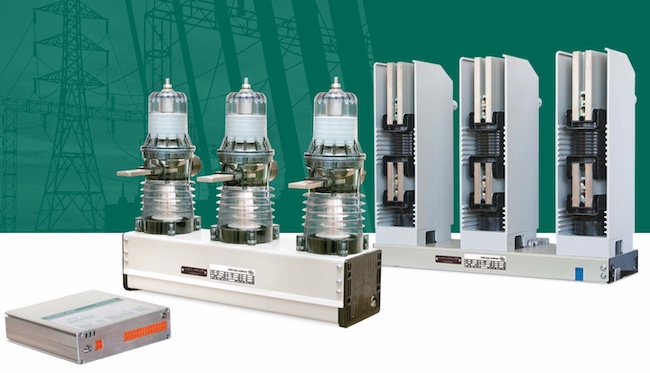
Of the many technical characteristics that are essentially the criteria for selecting vacuum circuit breakers (VCB), let us mention the main ones.
The rated voltage of the VCB (Ur) – is the pole-to-phase voltage (effective value) equal to the rated phase-to-phase voltage of the electrical network in which the circuit breaker is designed to operate.
Rated power frequency withstand voltage (Ud) – is the highest inter-pole voltage (effective value) for which the circuit breaker is designed (in particular under conditions of prolonged application of this voltage). This parameter is related to the phenomenon of overvoltage in the network.
Rated normal current (Ir) – the highest allowable under the conditions of heating parts of the circuit breaker load current in continuous operation, for which the circuit breaker is designed.
The rated breaking current of the VCB – is the highest effective value of the periodic component of the current that the VCB is designed to break under normalized conditions of its capacitance.
Rated voltage and current consumption of switching and disconnecting devices of the drive and auxiliary circuits – is the voltage (effective value) for which the switching and disconnecting devices of the drive and auxiliary circuits are designed (with normalized limit deviations).
Rated short-time withstand current (Ik) – the current that the switch must carry in the closed position for the rated short time under the prescribed conditions of use and behavior.
Rated duration of short circuit (tk) – the time for the through current of a short circuit breaker to flow through the switched on circuit breaker.
Peak short-time withstand current (electrodynamic withstand current) – is the value of the current peak that the VCB must withstand in the closed position under the prescribed conditions of use and behavior.
Switching capacity – the ability of the VCB to switch (switch on and off) electrical circuits under prescribed conditions:
- Switching capacity when switching on – the switching capacity determined by the inrush current;
- switching capacity at disconnection – disconnecting capacity determined by the disconnecting current.
Overvoltage – any voltage between one phase and ground or between phases that has a value greater than the corresponding peak of the highest operating voltage of the equipment. Switching off any loads must not be accompanied by overvoltages that are dangerous to the insulation of plant components.
The intrinsic switching time – the time interval between the moment of the command to switch on the VCB which is in the disconnected position and the moment when the contacts contact in all poles.
Weight and dimensions. Their influence on the choice of circuit breaker is associated with the limitations on the size of complete switchgear and the use of VCB for retrofit. Reducing the dimensions allows to reduce the cost of switchgear. It is possible by optimizing the electrical strength of the VDK contact system and increasing the density of disconnected currents per unit contact area. Dimensions and weight are often corrected by changing the design of the drive train, the supporting insulation and the use of lighter construction materials. It is important that this does not compromise product reliability.
Mechanical life is characterized by the number of cycles “on – random pause – off”, performed without current in the main circuit of the VCB, and the switching life is determined by the allowable for the circuit breaker total number of cycles “on – off” at rated currents and short circuit currents without inspection and repair arc-quenching device.
TAVRIDA ELECTRIC offers complex intelligent solutions for the construction and reconstruction of substations 10-35 kV, as well as automation of distribution networks 15-27 kV based on the use of vacuum circuit breakers and automatic circuit reclosers